

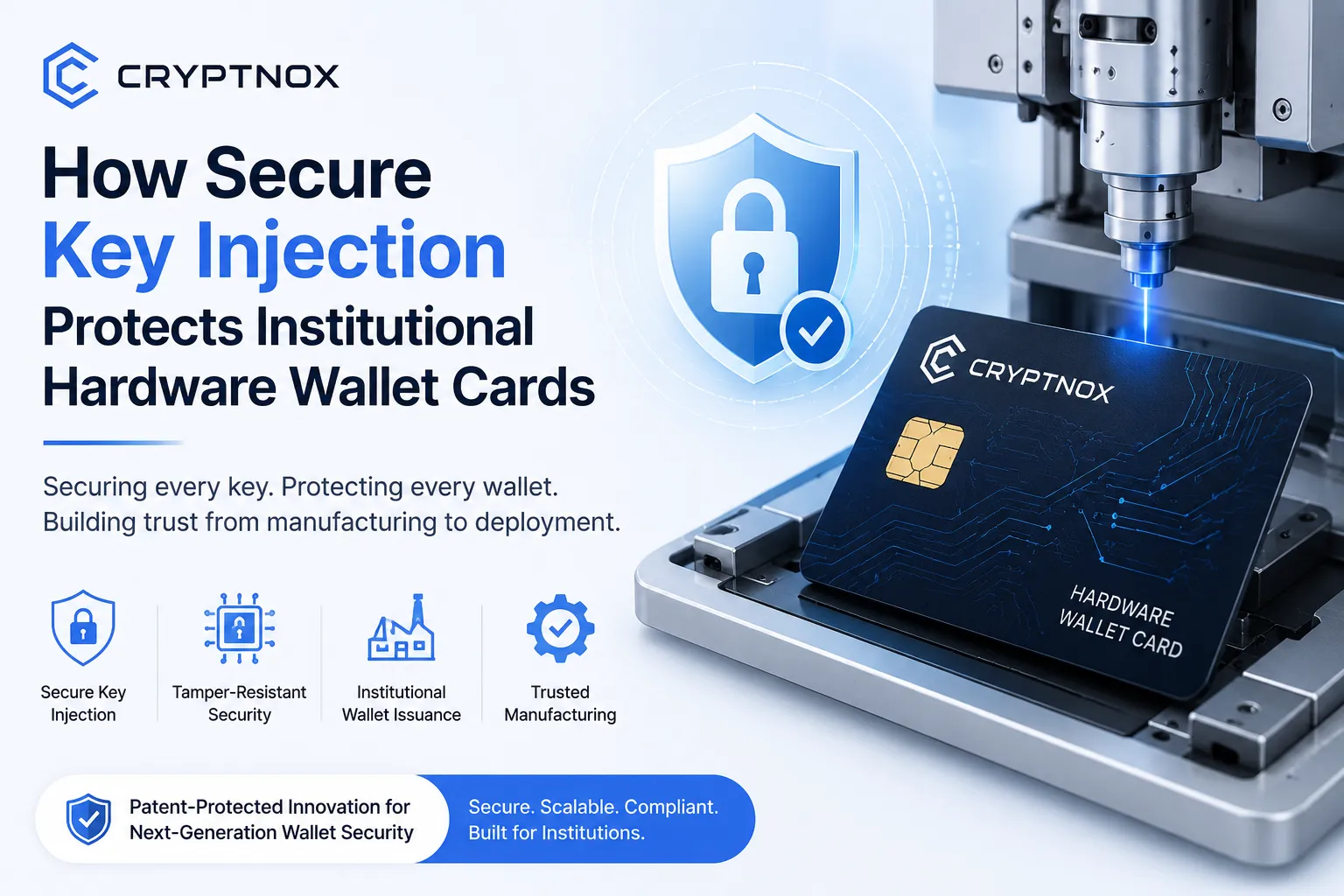
As digital assets become increasingly important to financial institutions, fintech companies, and enterprise organizations, securing cryptographic keys throughout the manufacturing process has become a top priority. A hardware wallet is only as secure as the method used to generate, inject, and protect its private keys. This is where Secure key injection plays a critical role. By securely provisioning cryptographic keys into tamper-resistant smart cards during manufacturing, organizations can reduce supply chain risks while ensuring every hardware wallet is ready for trusted deployment. For institutions launching self-custody solutions or large-scale wallet programs, secure key injection forms the foundation of a secure and scalable hardware wallet infrastructure.
What Is Secure Key Injection?
Secure key injection is the controlled process of generating, importing, and provisioning cryptographic keys directly into secure hardware during manufacturing or personalization. Instead of exposing sensitive private keys through insecure software environments, the keys are handled within highly protected systems designed to prevent unauthorized access.
For institutional hardware wallets, this process ensures that every wallet is initialized with unique cryptographic credentials while maintaining strict security controls throughout production.
Unlike traditional software-based provisioning, secure key injection minimizes opportunities for interception, duplication, or tampering.
Why Secure Key Injection Matters
Institutional deployments require a much higher level of security than consumer wallet production.
Banks, fintech companies, enterprise custodians, and digital asset providers often issue thousands of hardware wallet cards to customers or employees. During manufacturing, every device must receive unique cryptographic material without exposing sensitive information.
A properly implemented Secure key injection process helps organizations:
-
Protect private keys during production.
-
Reduce manufacturing risks.
-
Prevent unauthorized duplication.
-
Maintain secure supply chains.
-
Enable scalable wallet issuance.
-
Support enterprise-grade security policies.
These protections are essential for organizations handling valuable digital assets.
How Secure Key Injection Works
Although implementations vary depending on the hardware architecture, secure key injection generally follows several controlled stages.
Secure Key Generation
Cryptographic keys are generated within trusted secure environments using certified hardware security processes.
Protected Key Provisioning
The generated keys are securely transferred into tamper-resistant secure elements embedded within hardware wallet cards.
Secure Verification
Each device is verified to ensure that keys have been correctly provisioned without exposing sensitive information.
Controlled Manufacturing
Strict access controls, audit trails, and security procedures help ensure that only authorized systems participate in the manufacturing workflow.
This layered approach significantly strengthens hardware wallet security throughout production.
Strengthening Hardware Wallet Security
Private keys represent ownership of blockchain assets.
If attackers gain access to those keys during manufacturing, the integrity of the entire wallet ecosystem may be compromised.
A secure manufacturing process greatly improves Hardware wallet security by ensuring sensitive cryptographic material remains protected from generation through final deployment.
Combined with secure elements and smart card technology, secure key injection creates multiple layers of defense against supply chain attacks.
Why Institutions Require Secure Wallet Manufacturing
Enterprise wallet deployments involve far greater operational complexity than individual consumer wallets.
Organizations often require:
-
Large-scale wallet issuance.
-
Multi-user provisioning.
-
Secure lifecycle management.
-
Enterprise identity integration.
-
Regulatory security controls.
-
Auditable production workflows.
A strong secure wallet manufacturing process helps institutions maintain consistent security across every issued hardware wallet while supporting large-scale deployments.
This is especially valuable for financial institutions, payment providers, enterprise authentication systems, and digital asset platforms.
Supporting Institutional Hardware Wallet Issuance
Institutional wallet issuance requires repeatable, scalable, and secure production methods.
Secure key injection supports institutional hardware wallet issuance by allowing organizations to deploy thousands of hardware wallet cards while maintaining consistent cryptographic protection.
This approach helps organizations:
-
Reduce operational risk.
-
Improve production consistency.
-
Strengthen customer trust.
-
Enable enterprise-scale deployments.
-
Simplify wallet lifecycle management.
As institutional adoption of blockchain technology continues to grow, scalable issuance processes become increasingly important.
The Role of Patented Security Innovation
Advanced wallet manufacturing depends not only on secure processes but also on ongoing innovation.
Technologies covered by the Cryptnox patent demonstrate how secure key injection and institutional hardware wallet issuance can be designed to protect sensitive cryptographic operations throughout the production lifecycle.
Patent-backed innovation helps improve manufacturing security while supporting enterprise-grade deployment models for banks, fintech companies, and digital asset service providers.
Best Practices for Secure Hardware Wallet Manufacturing
Organizations planning hardware wallet programs should follow several best practices:
-
Use tamper-resistant secure elements.
-
Protect cryptographic keys throughout production.
-
Restrict manufacturing access.
-
Maintain detailed audit logs.
-
Validate every wallet before deployment.
-
Implement secure lifecycle management.
-
Regularly review manufacturing security procedures.
Combining these practices with secure key injection creates a stronger foundation for long-term digital asset protection.
The Future of Institutional Wallet Security
As blockchain adoption expands across enterprise environments, secure manufacturing will become increasingly important.
Organizations are moving beyond traditional software wallets toward hardware-backed self-custody solutions that offer stronger protection against cyber threats and supply chain attacks.
Secure key injection, smart card technology, and hardware-based cryptography will continue to shape the future of enterprise wallet infrastructure, enabling institutions to deploy secure digital asset solutions at scale while maintaining high security standards.
Conclusion
Protecting digital assets begins long before a hardware wallet reaches the end user. Secure key injection ensures that cryptographic keys are generated, provisioned, and protected within secure manufacturing environments, reducing supply chain risks and strengthening hardware wallet security from day one. For banks, fintech companies, and enterprise organizations deploying institutional hardware wallet cards, secure key injection provides the trusted foundation needed for scalable, secure, and reliable self-custody solutions. As institutional adoption of blockchain technology accelerates, secure manufacturing processes will remain a critical component of next-generation digital asset infrastructure.